Govern every SAP transport with a record you can verify.
TrackIt puts ordered gates, mandatory verification evidence, and enforced segregation of duties around your transport requests — recording every release decision in a tamper-evident audit ledger.
S4DK904218
FI-GL: Core Real-Time Settlement
Strict Dual Sign-off (SoD)
Production release gate: dual sign-off
Delivery Authority
Sarah Chen (PM Lead)
Business Owner
Julian Meyer (Finance VP)
Production release: on hold
TrackIt does not mark S4DK904218 ready for production import until both independent approvals are recorded.
Illustration with invented people and data. Not a real system.
Four ordered gates
Production needs two different people to sign off.
Tamper-evident ledger
Hash-chained entries you can verify offline.
Isolation in the database
Row-level security, tested in CI against a real database.
SSO and SCIM
SAML 2.0, OIDC and directory sync, set up by your admin.
The problem
Transport approvals live in inboxes.
When a production import goes wrong, or an auditor asks who approved it, the answer is scattered across email, chat and shared folders.
The Fragile Status Quo
Scattered across inboxes, spreadsheets & chats
- Approval decisions sit in email threads and chat messages.
- Test evidence and rollback plans live in local folders.
- Basis imports without structural proof that sign-offs happened.
- Emergency changes leave no central review trail.
Result: Weeks of stressful audit preparation and blind imports that jeopardize production.
The Architecture of Certainty
Ordered gates and a tamper-evident ledger
- Every decision is a recorded, attributable step in a fixed order.
- Evidence is attached to the transport it belongs to.
- A gate does not open until the one before it is complete.
- Emergency access is time-boxed, justified and on the record.
Result: an audit package you can verify offline, and a recorded approval behind every transport TrackIt releases.
How it works
Four gates. One order. No shortcuts.
A transport moves forward only when the gate before it is complete. Choose a gate to see who approves it and what evidence it needs.
Unit test & DEV to QAS
The change is complete in development and ready to move to quality. Technical evidence is logged before it can be released.
Unit-test evidence is attached before the transport leaves development; high-risk and customizing changes also need a rollback plan.
Example policy. In the current pilot, SAP responses come from a simulator.
Authorized Approver Roles
- Project manager
Mandatory Technical Evidence
- Unit test evidence
- Code review sign-off
- Rollback plan
SIT & QAS evidence
The transport has been imported into quality and integration testing has run. Basis movement is confirmed against the evidence.
Movement is reconciled against SAP import return codes: RC 4 or lower counts as imported, anything higher is flagged.
Example policy. In the current pilot, SAP responses come from a simulator.
Authorized Approver Roles
- Project manager
Mandatory Technical Evidence
- Basis import log
- System integration test evidence
UAT & business sign-off
Business users verify the change. Consultants can upload evidence, but only a business stakeholder can approve: the maker is never the checker.
Maker cannot be checker: the owner of a transport cannot approve its sign-off.
Example policy. In the current pilot, SAP responses come from a simulator.
Authorized Approver Roles
- Business stakeholder
Mandatory Technical Evidence
- Signed user acceptance test log
PRD deployment
Final sign-off before production. Two different people approve, one from delivery and one from the business; Basis then moves the transport.
Production sign-off needs two independent approvals, from the project manager and a business stakeholder.
Example policy. In the current pilot, SAP responses come from a simulator.
Authorized Approver Roles
- Project manager
- Business stakeholder
Mandatory Technical Evidence
- Production deployment confirmation
- Post-production validation
The product
What your release team works in.
The same screens your approvers, Basis administrators and auditors use every day.
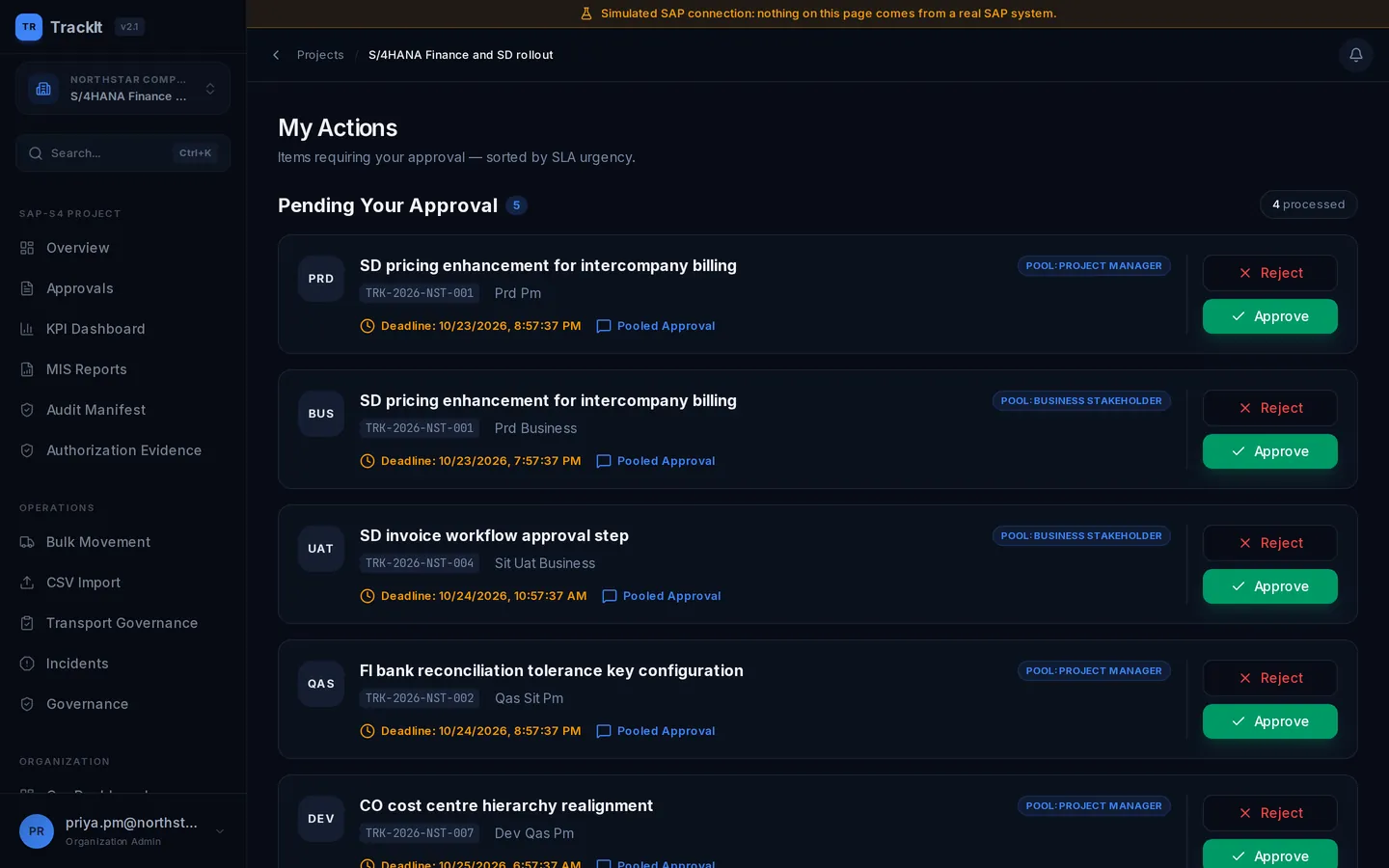
Approvals that cannot approve themselves.
- Gates open in order; a transport cannot skip one.
- Nobody approves a transport they raised.
- Production needs the project manager and a business stakeholder, never the same person.
- Approvers are reminded before an approval is overdue.
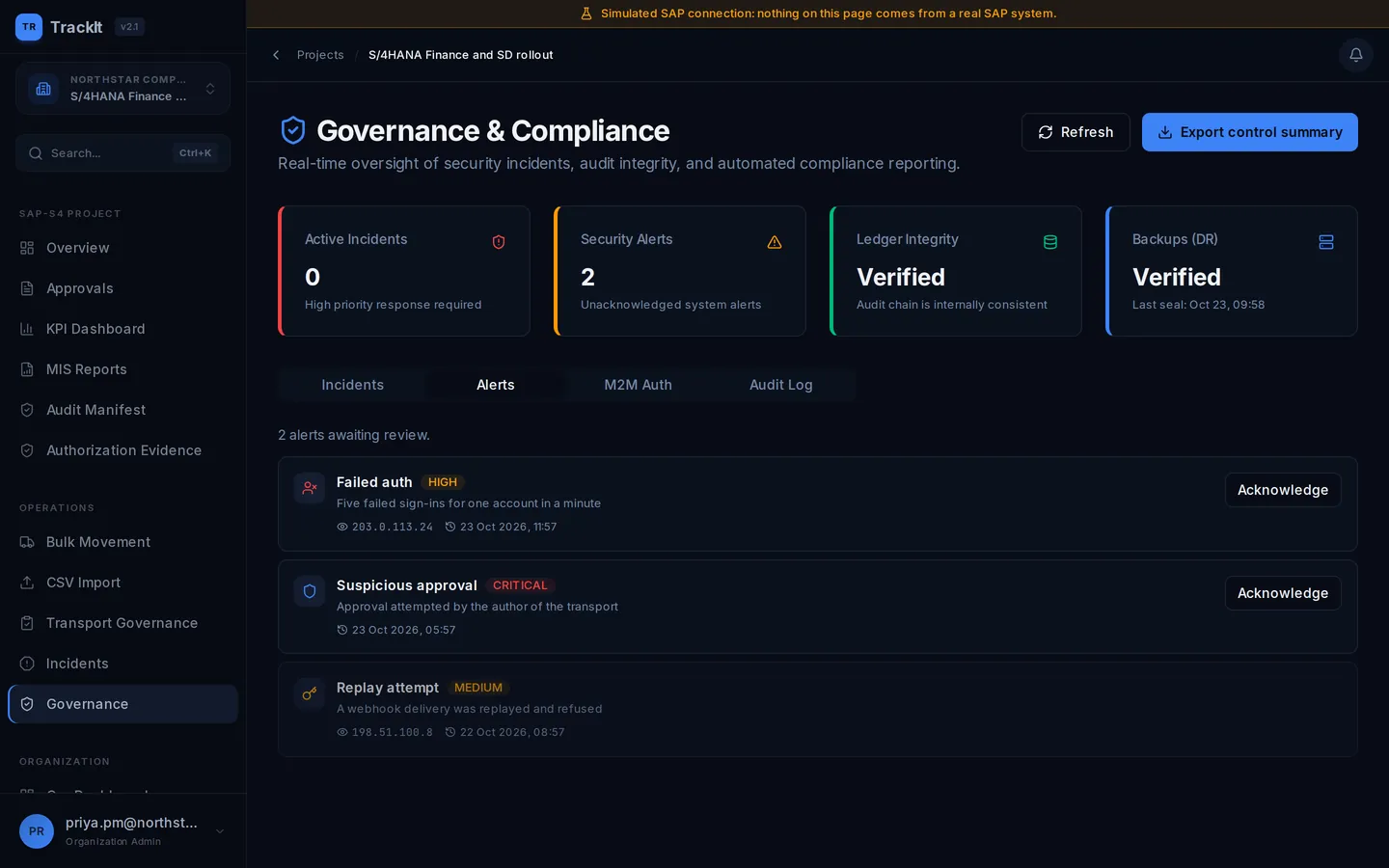
Emergency access with nothing hidden.
- Break-glass access needs an incident, is time-boxed and expires by itself.
- Security alerts are reviewed and acknowledged by an administrator.
- Every override is attributed to a person and recorded.
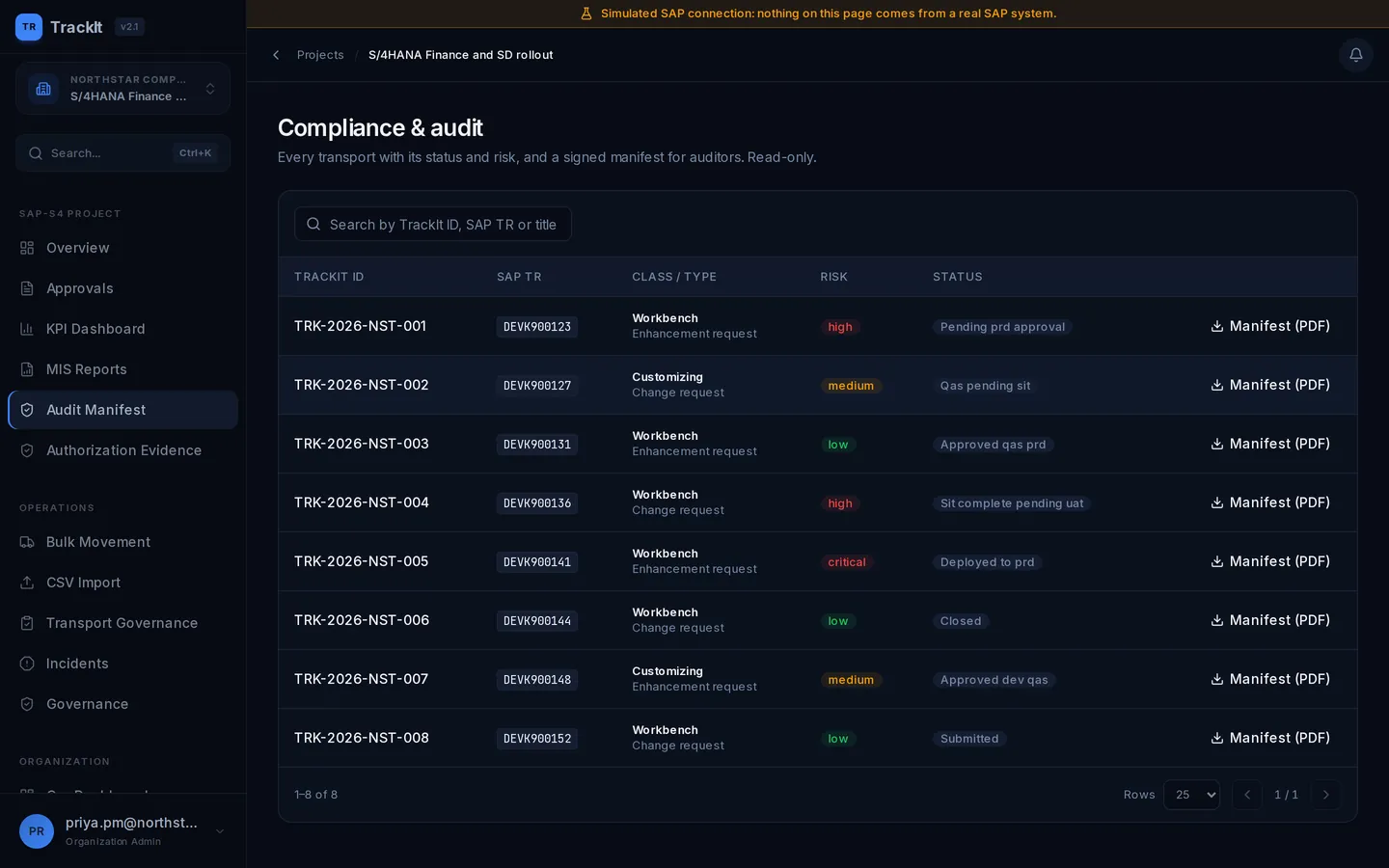
A record an auditor can verify.
- Approvals, evidence uploads and overrides are hash-chained entries.
- Verify the chain on demand, or offline against an export.
- Evidence stays attached to the transport it belongs to.
Identity and security
Built for the questions procurement asks.
What is implemented, stated plainly. The Trust page lists what is not done yet.
Your identity provider
Per-organization SAML 2.0 and OpenID Connect, set up by your own admin, with a verified domain. SCIM 2.0 syncs users and groups.
Tenant isolation
Each organization's data is separated by PostgreSQL row-level security, checked in CI. The platform operator cannot read your records.
Credentials stay protected
Credentials and secrets are encrypted at rest with AES-256-GCM, so a database copy does not expose them.
Nothing installed in SAP
No ABAP add-on and no transport into your landscape: only standard function modules are called.
Architecture
An overlay, not an add-on.
TrackIt sits beside your SAP landscape. It reads transport metadata through standard interfaces, runs the approval workflow, and keeps the record.
- Standard function modules only; nothing is deployed into SAP.
- A separate record of approvals and evidence per organization.
- Sign-in through your identity provider; roles inside TrackIt.
Unlike legacy change management tools, TrackIt requires no ABAP packages, no modification of standard SAP tables, and no transport imports into your core landscape.
Customer IdP
Okta / Entra ID / Ping
Directory Sync
SCIM User/Group Mapping
Role Context
Basis, PM, Auditor, Owner
Gate Engine
Ordered Dual Sign-offs
SoD Policy Engine
Maker != Checker Guard
Audit Ledger
Hash-Chained SHA-256
Development
WorkbenchQuality
SIT / RegressionProduction
Dual Sign-offWho it is for
One workflow for everyone who touches a release.
Basis administrator
Release Readiness View
Imports approved transports
Sees which gates are complete before moving anything
See which gates are complete for every transport, so nothing is imported to production ahead of its approvals.
See it on your own transports.
Tell us about your landscape and release process. We will walk you through the product with your workflow in mind.